
Interior Design Client Questionnaire vs. Image-Reaction Discovery: Which Captures Style Better?
A client questionnaire captures the words a client already has for their style. It misses how they actually react. Here's how the two compare, and how to use both.

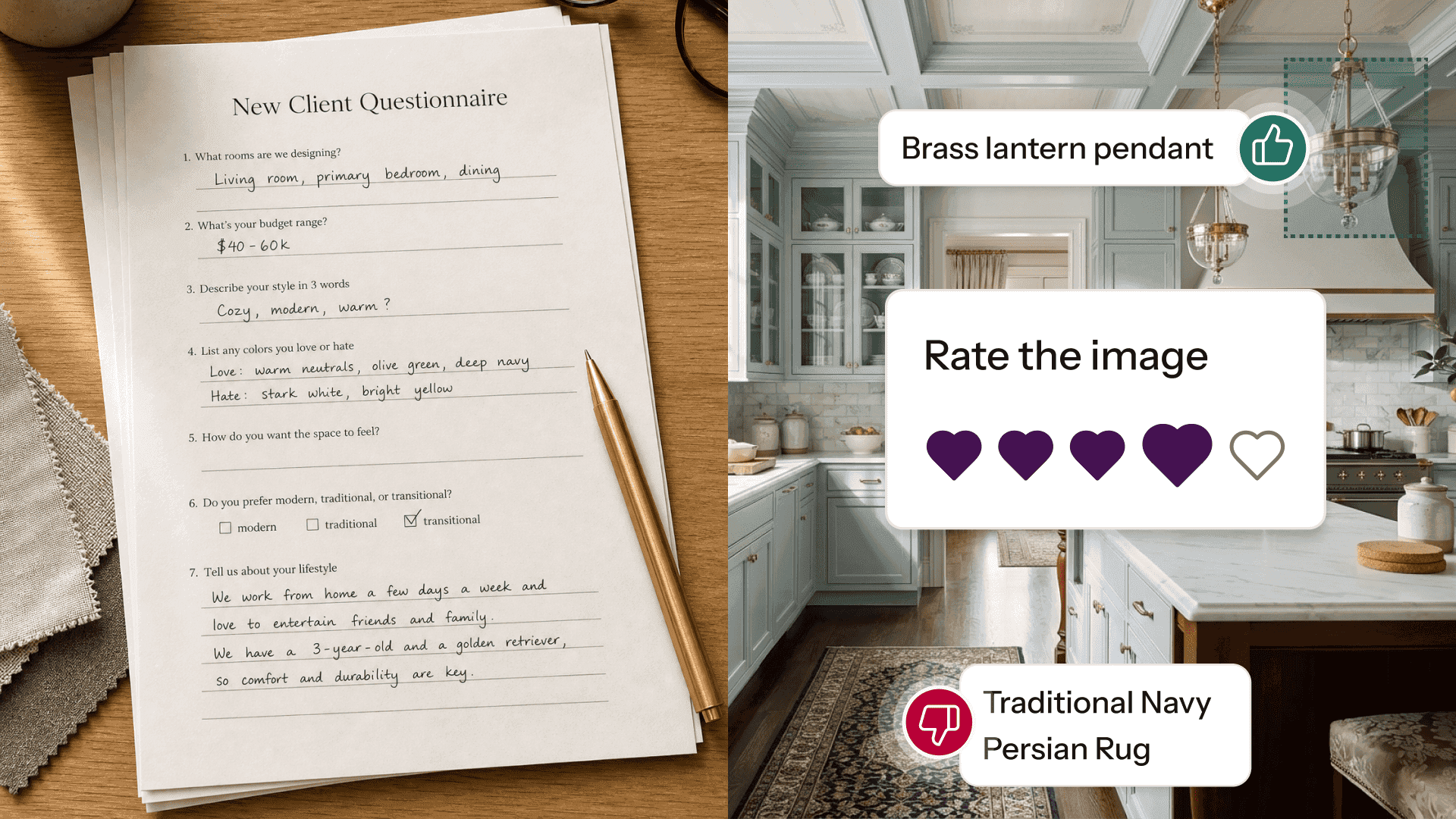
An interior design client questionnaire is useful for facts and logistics, but it captures the words a client already has for their style, not how they react when they see something real. For style direction specifically, image reactions are more accurate, because clients recognize what they want the moment they see it even when they cannot describe it in advance. The strongest discovery process uses both: a questionnaire for the practical details, image reactions for taste.
Almost every interior designer runs some version of a client questionnaire. It is the default first step, and for good reason. But if you have ever had a project go sideways despite a thorough intake form, you have felt the limit of what a questionnaire can do. Here is what each method is actually good at, where the questionnaire falls short, and how to combine them so you start every project with real clarity.
What is an interior design client questionnaire?
A client questionnaire is a set of questions a designer sends before or during the discovery phase to understand a new client. It typically covers project scope, budget, timeline, who lives in the space, how rooms get used, and a section on style preferences, usually a list of adjectives or styles to choose from.
It is the workhorse of onboarding, and it does a lot of useful jobs. The trouble is that the style section is asked to do something questions are not very good at.
What a questionnaire is great at
Keep using your questionnaire for everything it does well:
Facts and constraints. Budget, square footage, timeline, who uses each room, pets, deadlines, must-keep pieces.
Logistics and qualifying. Whether a client is a fit, what they expect, how decisions get made, who else needs to approve.
Setting expectations. A questionnaire signals that you have a process, which builds confidence before you have designed anything.
For all of this, a written form is a great tool, though you can also fill it out with the client at your side (interview/conversation style). None of what follows is an argument against questionnaires. It is an argument about one specific section: style.
Where questionnaires fall short on style
The style section asks clients to describe their taste in words. That is where the gap opens.
Clients have strong instincts about what they want. They know it the instant they see it. What they do not have is the vocabulary to describe it before they see it. So when your form asks them to pick "modern" or "transitional," or to describe their dream living room, they reach for the closest words they have, usually borrowed from Pinterest, HGTV, or a friend's renovation. Those words mean something different to every person who uses them.
The result is a style section full of answers that feel informative but quietly mislead. A client checks "modern" and means warm mid-century. Another checks the same box and means cool and minimal. You design from the word, not the meaning, and the gap shows up later as a revision round.
A questionnaire asks. It cannot watch. And with style, watching is where the real signal is.
Image-reaction discovery: the other half
Image-reaction discovery flips the method. Instead of asking clients to describe their style, you show them real spaces and pay attention to how they respond. What they stop on, what they skip, what they would never put in their home. They are not translating a feeling into words. They are reacting directly to the thing, which is exactly what they do every time they look at a room.
This closes the gap the questionnaire leaves open. A client who cannot articulate why they love a space will still react to it instantly and consistently. Their reactions, gathered across enough images, form a far more accurate picture of their taste than any list of adjectives.
The practical version: before the discovery call, send 20 to 30 images drawn from the project inspiration, your own past work, and the client's own saved images. Watch the patterns in what they respond to. You will learn more from that than from any "describe your style" prompt.
Questionnaire vs. image reactions: side by side
Client questionnaire | Image-reaction discovery | |
|---|---|---|
Best for | Facts, budget, scope, logistics | Style, taste, material and color direction |
What it captures | The words a client already has | How a client actually responds |
Client effort | Can feel like homework | Fast and intuitive, often enjoyable |
Accuracy on style | Low, depends on shared vocabulary | High, based on direct reaction |
Where it fails | Style preferences clients cannot yet name | Hard logistical details and constraints |
When to use | Onboarding and qualifying | Defining creative direction before concepts |
The takeaway is not "questionnaire bad, reactions good." It is that they capture different things, and most studios only use the first.
How to combine both in your process
You do not have to choose. The cleanest discovery process layers them:
Send the questionnaire first for scope, budget, timeline, and logistics. Keep the style section short, or drop it entirely, since the next step does that job better.
Send 20 to 30 images for reactions before the discovery call. Pull from project inspiration, your past work, and the client's saved images for a real spectrum.
Read the patterns in what they loved, skipped, and rejected. Turn those into a clear direction in real terms: the materials, palette, and references they consistently responded to.
Confirm it at the kickoff. Bring the direction to the call and align on it together, so you are confirming what you already know instead of guessing.
You keep everything the questionnaire is good at and add the one thing it was never built to capture.
Stop asking clients to describe their taste
The reason image reactions work is the reason questionnaires struggle: style preference forms as a fast reaction to something real, and only later gets translated into words. A form is limited by the client's vocabulary. The medium matters more than the questions you ask when it comes to discovering your clients' style.
That is the gap Glintera's Style Profiler was built to close. Your client gets a link, no account or app required. They rate inspiration images, tag what they love and what they would never live with, and add a note if they want to. What comes back is a complete style profile, with the archetype, color preferences, materials, and a per-room breakdown, before you have started designing, each part tied to images they actually reacted to. It does not replace your questionnaire. It replaces the part of it that was never working.
FAQ
Do interior design client questionnaires work?
Yes, for the right job. Questionnaires are excellent for capturing facts, budget, scope, timeline, and logistics. Where they fall short is style, because they ask clients to describe taste in words they often do not have yet. For style direction, pairing the questionnaire with image reactions gives a far more accurate read.
What is better than a client questionnaire for figuring out style?
Image-reaction discovery is more accurate for style specifically. Instead of asking clients to describe their taste, you show them real spaces and observe how they react. Clients recognize what they want instantly even when they cannot describe it, so their reactions reveal more than any list of adjectives. The best approach uses a questionnaire for logistics and image reactions for taste.
Why do clients give misleading answers about their style?
Not because they are difficult, but because their vocabulary is limited. Style preference forms as a gut reaction, and the words come second. When a client picks "modern" or "warm," they are converting a feeling into borrowed language that means different things to different people. The answer feels informative but often points in the wrong direction.
How many images should I send a client for style discovery?
Around 20 to 30 is a good range. Enough variety that their reactions form a real pattern, but not so many that it becomes a chore. Pull from the project inspiration you have gathered, your own past work, and the client's own saved images so the spectrum reflects both your range and theirs.
Should I stop using my client questionnaire?
No. Keep it for what it does well: scope, budget, timeline, logistics, and qualifying. Just shorten or replace the style section, which is the part questionnaires handle poorly, and capture style through image reactions instead.
{"@context":"https://schema.org","@type":"FAQPage","mainEntity":[{"@type":"Question","name":"Do interior design client questionnaires work?","acceptedAnswer":{"@type":"Answer","text":"Yes, for the right job. Questionnaires are excellent for capturing facts, budget, scope, timeline, and logistics. Where they fall short is style, because they ask clients to describe taste in words they often do not have yet. For style direction, pairing the questionnaire with image reactions gives a far more accurate read."}},{"@type":"Question","name":"What is better than a client questionnaire for figuring out style?","acceptedAnswer":{"@type":"Answer","text":"Image-reaction discovery is more accurate for style specifically. Instead of asking clients to describe their taste, you show them real spaces and observe how they react. Clients recognize what they want instantly even when they cannot describe it, so their reactions reveal more than any list of adjectives. The best approach uses a questionnaire for logistics and image reactions for taste."}},{"@type":"Question","name":"Why do clients give misleading answers about their style?","acceptedAnswer":{"@type":"Answer","text":"Not because they are difficult, but because their vocabulary is limited. Style preference forms as a gut reaction, and the words come second. When a client picks modern or warm, they are converting a feeling into borrowed language that means different things to different people. The answer feels informative but often points in the wrong direction."}},{"@type":"Question","name":"How many images should I send a client for style discovery?","acceptedAnswer":{"@type":"Answer","text":"Around 20 to 30 is a good range. Enough variety that their reactions form a real pattern, but not so many that it becomes a chore. Pull from the project inspiration you have gathered, your own past work, and the client's own saved images so the spectrum reflects both your range and theirs."}},{"@type":"Question","name":"Should I stop using my client questionnaire?","acceptedAnswer":{"@type":"Answer","text":"No. Keep it for what it does well: scope, budget, timeline, logistics, and qualifying. Just shorten or replace the style section, which is the part questionnaires handle poorly, and capture style through image reactions instead."}}]}
