
How to Read Sherwin-Williams Paint Codes: What the Numbers Actually Mean
Only one code on a Sherwin-Williams chip is the actual color name. Here's what the SW number, locator, LRV, and colorant formula each mean, and the value the chip leaves off.


Every Sherwin-Williams color carries several different identifiers: the SW number that uniquely names the color, a locator number that only describes where the chip lives in the store display, an LRV that tells you how much light it reflects, and a colorant formula printed on the can at mixing time. For digital work, what you usually want is none of these. You want the color's hex or RGB value, which Sherwin-Williams doesn't print on the chip at all.
Pick up a Sherwin-Williams chip and you'll find a small pile of numbers and letters on it. Most of them answer different questions, and only one of them is the actual name of the color. Here's what each code means, which ones matter for specifying paint, and how to get the one value the chip doesn't give you.
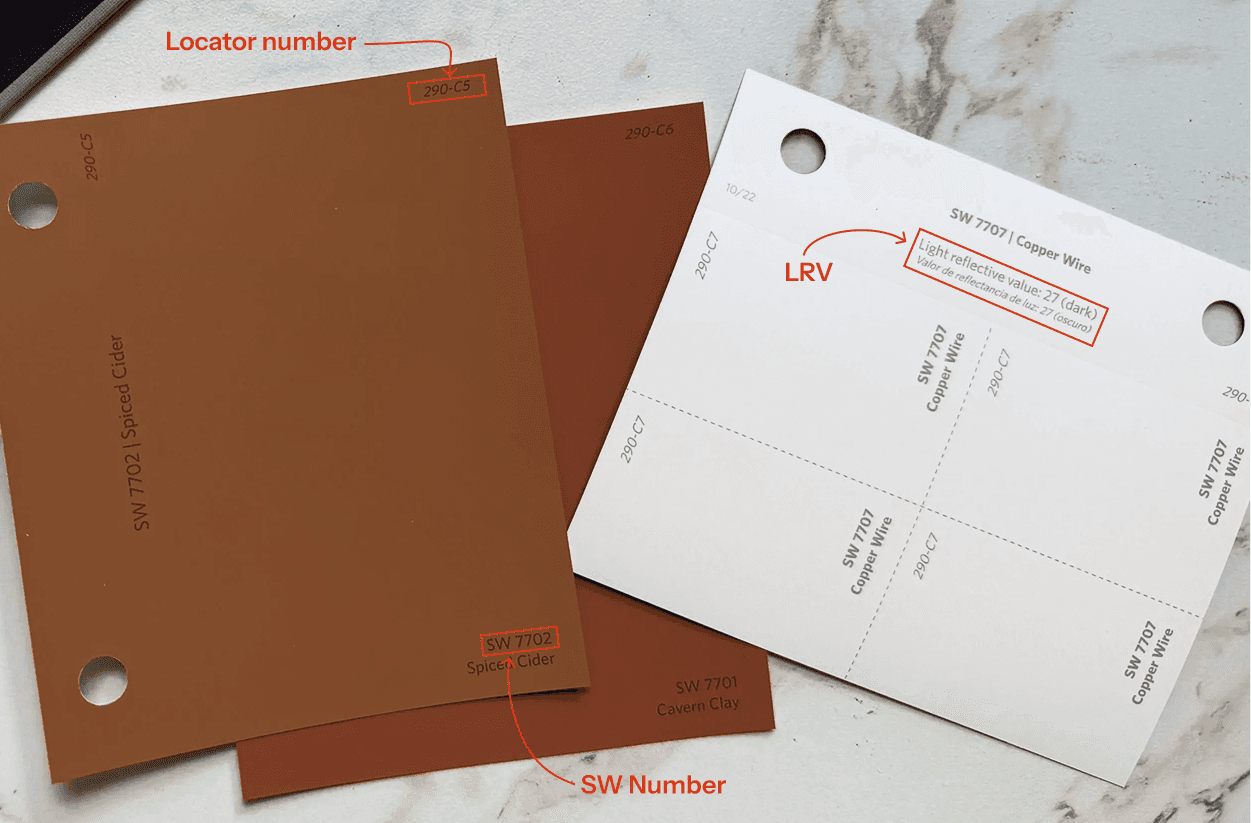
The SW number: the color's real identity
The code that matters most is the SW number, like SW 7029 (Agreeable Gray) or SW 6244 (Naval). This is the unique, permanent identifier for the color. It's what belongs on your spec sheets, purchase orders, and client documents, because names alone can collide or change while the number doesn't.
The numbering is organizational, not descriptive: it doesn't tell you the hue, undertone, or lightness of a color. Most of the modern designer palette sits in the 6000s and 7000s, and the 9000s are recent additions like Evergreen Fog (SW 9130). The number is an ID, not a description.
The locator number: ignore it on your specs
Chips also carry a locator code, something like 256-C2. This describes the chip's physical position in the in-store color wall: column, row, and slot. It exists so a store associate can restock the display, and it varies by display system. It has no place on a specification. If a contractor reads you a locator number over the phone, ask for the SW number instead.
LRV: the number designers should actually read
Light Reflectance Value appears on the back of most chips, on a scale from 0 (absorbs all light) to 100 (reflects all light). It's the most underused number on the chip. LRV tells you how a color will behave in a space: whether that gray will go cave-dark in a north-facing room, or whether two whites that look identical on a chip will read differently on a large wall. As rough guideposts, most whites and bright neutrals sit above 70, mid-tone neutrals in the 50s and 60s, and moody accent colors below 20.
The colorant formula: the can's recipe
When paint is mixed, the can label gets a formula code listing colorants and quantities, like B1 (black) or Y3 (deep gold) with their measurements. This is the recipe the store's tinting machine used in a specific base. It's useful for re-ordering an exact custom mix, but for a standard catalog color, the SW number alone is enough for any store to reproduce it.
The number that isn't on the chip: hex and RGB
Here's the gap. The chip tells you everything about buying the paint and nothing about using the color digitally. The moment you need Agreeable Gray in a Canva board, a SketchUp material, or a client presentation, you need its hex or RGB value, and the chip doesn't carry it. Sherwin-Williams does publish these values, but in downloadable color palettes and PDFs, not on the chip in your hand.
That's a lookup problem, and the faster path is a tool that skips the spreadsheet hunt. Glintera's free paint color tool maps every Sherwin-Williams color (along with Benjamin Moore and Farrow & Ball) to its hex and RGB values. Type the name or SW number, copy the code, paste it into your software. It works in reverse too: paste any hex code and get the closest named SW colors back, across all three brands in one place.
Quick reference: which code for which job
You're doing this | Use this |
|---|---|
Writing a spec or purchase order | SW number (SW 7029) |
Predicting how light or dark it lives in a room | LRV |
Re-ordering a custom tint exactly | Colorant formula on the can |
Restocking a store display | Locator number (you'll never need this) |
Mood boards, renderings, presentations | Hex / RGB from a lookup tool |
FAQ
What does the SW number on a paint chip mean?
The SW number, like SW 7029, is the unique identifier for that Sherwin-Williams color. It's permanent and unambiguous, which makes it the right code for spec sheets and orders. The numbering is organizational, not descriptive, so the number itself tells you nothing about the color's appearance.
What is the locator number on a Sherwin-Williams chip?
It's a store-display address, like 256-C2, identifying the chip's column and slot in the color wall so staff can restock it. It isn't a color identifier and shouldn't appear on specifications. Always use the SW number instead.
What is a good LRV for interior walls?
It depends on the room's light and the mood you want. Most whites and bright neutrals sit above 70, versatile mid-tones in the 50s and 60s, and dramatic colors below 20. In dim or north-facing rooms, colors with lower LRVs will read significantly darker than the chip suggests, so check the LRV before committing.
How do I get the hex code for a Sherwin-Williams color?
Sherwin-Williams publishes RGB and hex values in its downloadable color palettes, but not on the physical chip, so the quickest path is a lookup tool. Glintera's free paint color tool returns the hex and RGB for any SW color by name or number, free and without an account. The value is a close digital equivalent for boards and renderings rather than an exact reproduction of the physical paint.
Can a Sherwin-Williams store match a color using just the name?
Yes, for catalog colors. The store's system retrieves the standard formula from the SW number or name. For custom or adjusted tints, keep the colorant formula printed on the original can, since that's the only record of the exact recipe.
{"@context": "https://schema.org", "@type": "FAQPage", "mainEntity": [{"@type": "Question", "name": "What does the SW number on a paint chip mean?", "acceptedAnswer": {"@type": "Answer", "text": "The SW number, like SW 7029, is the unique identifier for that Sherwin-Williams color. It's permanent and unambiguous, which makes it the right code for spec sheets and orders. The numbering is organizational, not descriptive, so the number itself tells you nothing about the color's appearance."}}, {"@type": "Question", "name": "What is the locator number on a Sherwin-Williams chip?", "acceptedAnswer": {"@type": "Answer", "text": "It's a store-display address, like 256-C2, identifying the chip's column and slot in the color wall so staff can restock it. It isn't a color identifier and shouldn't appear on specifications. Always use the SW number instead."}}, {"@type": "Question", "name": "What is a good LRV for interior walls?", "acceptedAnswer": {"@type": "Answer", "text": "It depends on the room's light and the mood you want. Most whites and bright neutrals sit above 70, versatile mid-tones in the 50s and 60s, and dramatic colors below 20. In dim or north-facing rooms, colors with lower LRVs will read significantly darker than the chip suggests, so check the LRV before committing."}}, {"@type": "Question", "name": "How do I get the hex code for a Sherwin-Williams color?", "acceptedAnswer": {"@type": "Answer", "text": "Sherwin-Williams publishes RGB and hex values in its downloadable color palettes, but not on the physical chip, so the quickest path is a lookup tool. Glintera's free paint color tool returns the hex and RGB for any SW color by name or number, free and without an account. The value is a close digital equivalent for boards and renderings rather than an exact reproduction of the physical paint."}}, {"@type": "Question", "name": "Can a Sherwin-Williams store match a color using just the name?", "acceptedAnswer": {"@type": "Answer", "text": "Yes, for catalog colors. The store's system retrieves the standard formula from the SW number or name. For custom or adjusted tints, keep the colorant formula printed on the original can, since that's the only record of the exact recipe."}}]}
